This article is a pre-print of my bi-monthly Cool Fuel column in Cold Facts — the magazine of the Cryogenic Society of America.
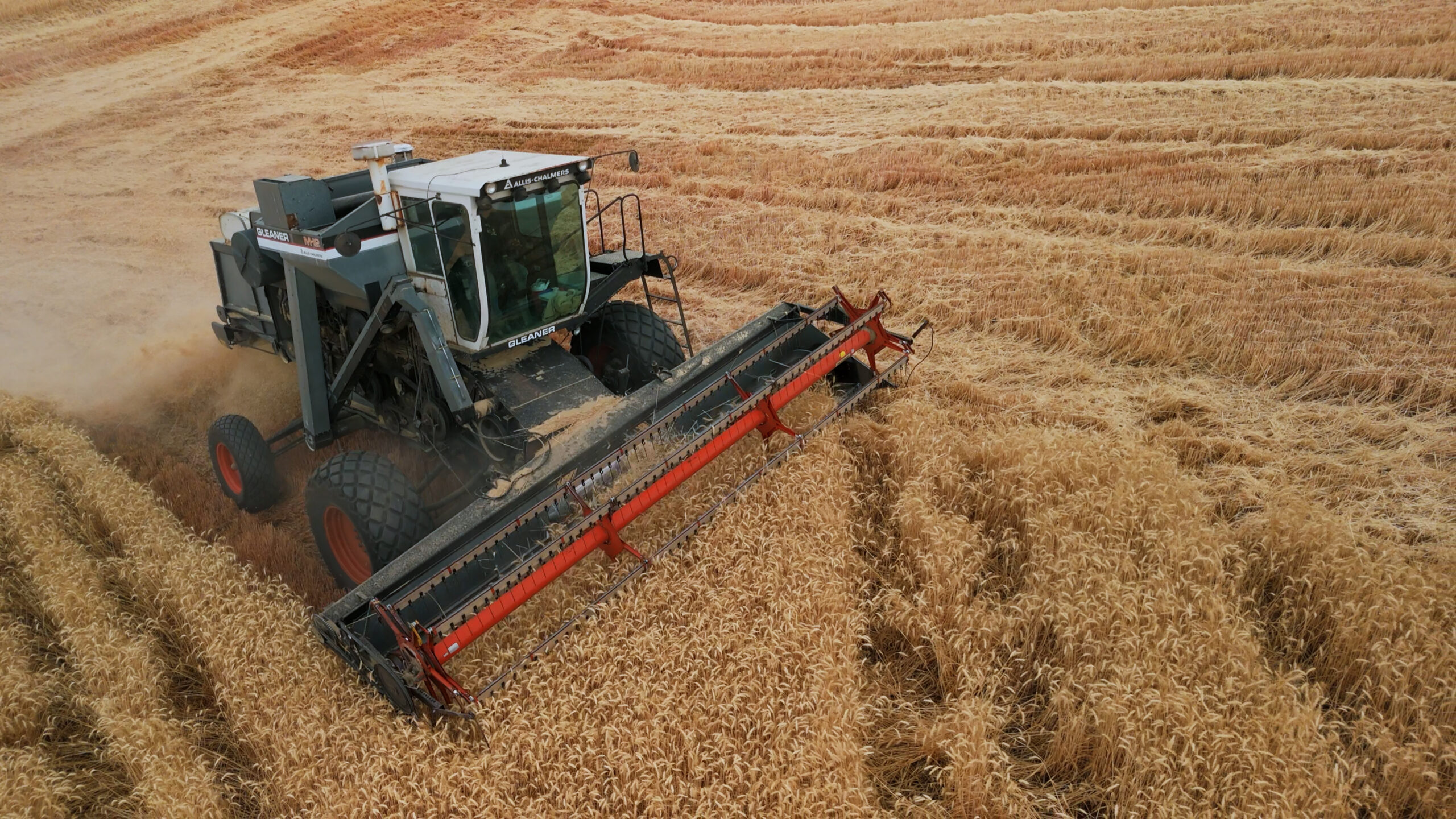
It’s harvest time here on the Palouse, and as I watch mastodon-esque combines rumble over the hills of wheat stretching as far as I can see, I am imagining a different future for the hydrogen economy. A future where we don’t have to pay to construct a network of refueling stations or clean heavy-duty vehicles, and we don’t need centralized hydrogen production or distribution systems. Let’s take a ride through the energy-independent farm of the future, courtesy of liquid hydrogen.
Our guides on this tour are Kyle Appel and Matthew Shenton, both HYPER lab members who grew up on farms and ranches here in the Pacific Northwest (PNW). The typical family farm on the Palouse ranges from 1-3 thousand acres with 1-3 combines, 1-3 tractors, 1-3 utility trucks, 1-3 family members trained in engineering, and 1-3 insurance policies covering a range of factors most of us should be thankful we avoid. Most importantly, farmers and ranchers reap what they sow – hence, they value free markets and the ability to forecast costs. Their two largest concerns are the prices of fuel and fertilizer, nearly all of which is imported into the PNW as we ran out of fossil hydrogens back in the 1960s. As a result, farmers must settle on the price they are offered for energy imports, make food from the imports, and then settle again on the commodity price offered for those food products. Any farmer I know would jump at the opportunity to take more control over their energy costs; energy independence is freedom.
Kyle and Matthew understand hydrogen is key to energy independence on a farm. Small renewable energy installations allow local production of hydrogen via electrolysis. Unlike electricity going on the power-grid, generating hydrogen on-site has immediate local benefits as the price of fuel increases the farther it is transported. In addition to readily available fuel, having hydrogen on-site is the first key to producing ammonia fertilizer, which is now possible on-farm due to smaller scale systems in production from several companies. Approximately 6 acres of solar could generate enough hydrogen over the course of 4 months to produce 4300 kg of liquid hydrogen, about what it would take to fuel a PNW farm’s combines through the month-long harvest. Matthew’s thermoacoustic hydrogen cooling and liquefaction research shows the potential to scale down hydrogen coolers in size while maintaining relatively high efficiencies.[1] Such a small-scale cooler allows liquid hydrogen tanks to become liquefiers, improving transfer performance while eliminating boil-off losses. With every hydrogen tanker integrated with a liquefier/cooler, each farm could park a fuel tanker for filling throughout the year so it’s ready for the sprint at harvest. Equipment could be fueled with the tanker parked, or the tanker could be driven to the equipment in a field. However, significant changes to technology are required for an off-road liquid hydrogen transfer.
Current National Fire Protection Association (NFPA) hydrogen codes require liquid transfers to occur over non-flammable pavements, with significant personal protective equipment (PPE) in case liquid air and concentrated oxygen were to drip onto combustible materials (just imagine wheat straw). However, installing expensive concrete pads in fields is a non-starter for most farmers, so Kyle patented and developed a deployable fire-barrier blanket with liquid oxygen droplet prevention for uneven terrain[2]. Transfer line purging and chill-in could be improved with a novel liquid hydrogen refueling coupler prototype developed by an undergraduate team with Reagan Dodge at HYPER. The coupler is error-proofed for public use and acts like a combination of a quick-connect and a bayonet fitting.[3] No rules seem to preclude liquid hydrogen transfers at off-road sites; there just has never been a use case to develop the enabling technologies.
Hydrogen-fueled heavy-duty vehicles are already in development; however, most anticipate this progress slowing down with the refueling station infrastructure delays. Pivoting to agriculture allows hydrogen integration efforts to be applied to the retrofitting of existing diesel engines for hydrogen fuel, the installation of advanced fuel-cell systems for novel electric farm equipment, and the continued progress of refueling technologies and standards. Earth compaction is a significant challenge on the farm that will all but preclude battery-electric vehicles from this market. Our estimates indicate that hydrogen fuel-cell farm equipment with liquid hydrogen tanks is comparable in mass to existing equipment. Fuel cell systems would dramatically reduce the risk of engine compartment fires, which are the primary cause of fires during harvest. Although liquid hydrogen tanks are becoming available for truck applications, costs need to drop significantly to be relevant for agricultural equipment.
Significant research and development is still needed to make the hydrogen-fueled farm a reality. However, I think it’s time to give it a hard look as we’re getting close to the point of technological maturation where a demonstration farm could yield significant findings. Towards this end, Kyle and Matthew recently started a company, CryoCowboys LLC, to commercialize liquid hydrogen technologies for immediate and effective use in the agricultural sector and demonstrate energy independence on their own family enterprises.
[1] Matthew P. Shenton, Jacob W. Leachman, and Konstantin I. Matveev, “Study of Taconis-Based Cryogenic Thermoacoustic Engine with Hydrogen and Helium,” Energies 18, no. 15 (2025), https://www.mdpi.com/1996-1073/18/15/4114.
[2] Appel K, Shenton M, Leachman J. A deployable barrier preventing liquid oxygen accumulation and safety risks during liquid hydrogen transfers. IOP Conference Series: Materials Science and Engineering: IOP Publishing; In Review. 2025.
[3] https://news.wsu.edu/news/2025/04/30/wsu-students-named-finalists-in-nasa-competition/