Student: “What’s Land-grant?”
Me: “What do you mean ‘What’s Land-grant’? You’re sitting in one.”
We were preparing to start our weekly lab meeting when the entire meeting was derailed by that innocent question. As usual, I looked around the table to allow someone else to answer, nothing. So I asked who in the room knew what a Land-Grant Institution was. Nothing. So I asked who knew what Morrill Hall on campus was named after? Nothing. I’m starting to hyperventilate. I’ve got the best students in the College in my lab. Sometimes I kid myself though. So the next week I asked a Junior level Honors College class. One hand was raised confidently out of thirty people, three to four others had heard of it.
I’ve discovered the root of our problems.
“What’s Land-grant?”
Historically, the idea for Land-Grant Universities originates with President George Washington’s final address to Congress, where he requested what he believed necessary to secure the future of our fledgling democracy:
- Collegiate education of “our Youth from every quarter”,
- Agriculture boards to increase information sharing of best practices,
- Advanced training in military sciences, and
- Development of our manufacturing base (a.k.a. the mechanic arts).
Thomas Jefferson would follow in Washington’s desire for systems of Collegiat education, “Above all things I hope the education of the common people will be attended to; convinced on their good sense we may rely with most security for the preservation of a due degree of liberty.” However, Jefferson only succeeded in creating the University of Virginia.
Washington’s more systemic foresight would prove to be prescient. It would take 70 years for Congress, specifically President Abraham Lincoln during the Civil War, to create a system for Land-Grant Universities with the Morrill Acts of 1862 and 1890 to form public universities of higher education in each state or territory from the proceeds of federal land sales. To say that Lincoln saw education as the cure to the problems of the time is an understatement, “I can say that I view education as the most important subject which we as a people can be engaged in.” The original act states:
“An Act donating public lands to the several states and territories which may provide colleges for the benefit of agriculture and the mechanic arts… where the leading object shall be, without excluding other scientific and classical studies, and including military tactics, to teach such branches of learning as are related to agriculture and the mechanic arts, in such manner as the legislatures of the states may respectively prescribe, in order to promote the liberal and practical education of the industrial classes in the several pursuits and professions in life.”
I take great pride in being a Faculty member of a founding discipline in the only Land-Grant Institution bearing Washington’s name.
Land-Grant Institutions focusing on engineering would prove signficantly more important than solving the issues of the Civil War. In 1862, American engineers were mostly educated at the United States Military Academy, on fortress construction, and their instructors were the authors of most engineering texts of the day. Here are numbers tracking the training of US engineers immediately after passing of the Morrill Acts:
- 1866: 6 colleges produced 300 engineers/year.
- 1870: 21 colleges produced 866 engineers/year.
- 1880: 2,249 engineers/year
- 1911: 3,000 engineers/year (compared to Germany’s 1800/year)
The US became the world leader in technical education in under 50 years after the original Morrill Act. Specifically, the combination of engineering with military sciences would prove crucial in winning the subsequent World Wars and Cold War.
Land-grant Institutions have proven time and again to be one of Humanity’s greatest gifts to the people of a free society, such that the people may educate and save themselves. A map of Land-Grant and tribal universities is below: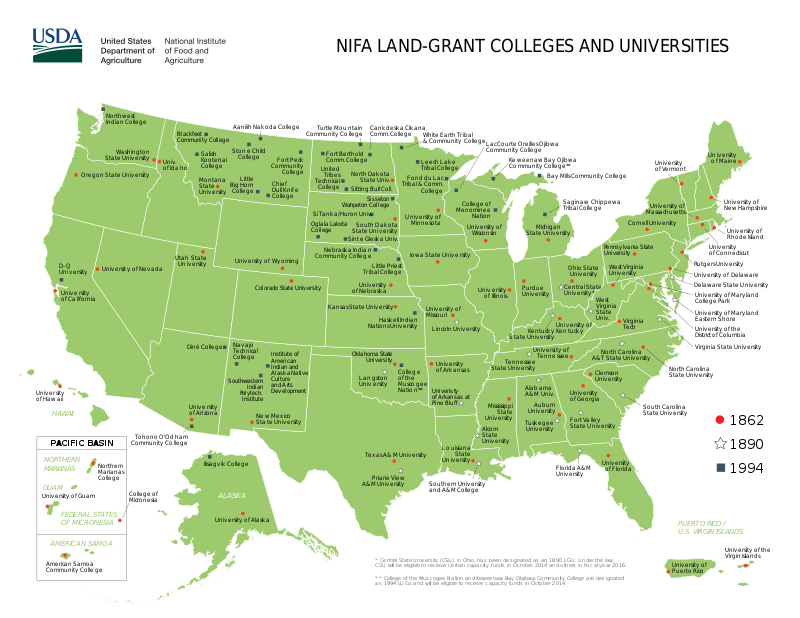
The Land-grant mission has evolved through the years. Kenyon Butterfield, the former President of the University of Rhode Island and driver of the Smith-Lever Act of 1914 that created the extension branches of Land-grant Institutions, published many works on the problems afflicting rural communities of the 20th Century. Chapters in rural progress is one of several focusing on the problems of education for rural communities. Butterfield viewed the Land-grant institutions as a grand equalizer bridging the socio-economic disparities already emerging between urban and rural life:
“We conclude, then, that the farm problem consists in maintaining upon our farms a class of people who have succeeded in procuring for themselves the highest possible class status, not only in the industrial, but in the political and the social order–a relative status, moreover, that is measured by the demands of American ideals. The farm problem thus connects itself with the whole question of democratic civilization.” Pg. 15
Going back to Washington’s original use of, “our Youth from every quarter,” we see now that Land-grant Universities were never intended to be the most elite, though we often are. Land-grant Universities were intended to add the most value to anyone willing to work hard for their education. In this manner, Land-grant Institutions are primary creators of the socio-economic mobility bridging the urban vs. rural divide necessary to sustain a democracy.
Modern challenges facing Land-grant Institutions
In 2020, High Country News conducted an investigation titled “Land-grab Universities” pointing out that the 21M acres allocated to support Land-grant Universities was stolen from indegenous peoples, resulting in generations of irrevocable harm. Washington State University is located on the historic lands of the Nimiipuu and Palus peoples. As a relative of Daniel Boone, the fabled Pioneer who helped settle the area of Kentucky as part of the western charge of manifest destiny, I was deply troubled by this association. My grandfather, who was related to Boone, had the deapest respect for our land of anyone I’ve known. He grew up in a skid house on Craig Mountain, was a ranch-hand in Hell’s Canyon before it became a National Monument, and later drafted into World War 2. He would sit with me outside of his house for long hours explaining the connections between life and nature that only he seemed to see. In the end, my grandfather seemed to have more connection and respect with the land and our Native peoples who steward it than our modern bureacracies. My Grandfather seemed to have reached the same conclusion as Daniel Boone. I can’t change that the Land-granted was taken from Native peoples today, but I can do my best to make it right. I’m proud that WSU is partnered with 13 signatory tribes to sustain the land and our region.
Many believe that the higher education system has aligned with a political party and is now being vilified by the other. The map below, developed by WSU graduate student Ryne Rohla, was one of the first to show precinct-level change in voting tendencies across the US for the 2016 Presidential Election. What is clear to see is that the urban centers shifted harder to the left, the rural populaces generally harder to the right. This gaping rural versus urban divide is analogous to the divide that Kenyon Butterfield hoped the Land-grant institutions would bridge.
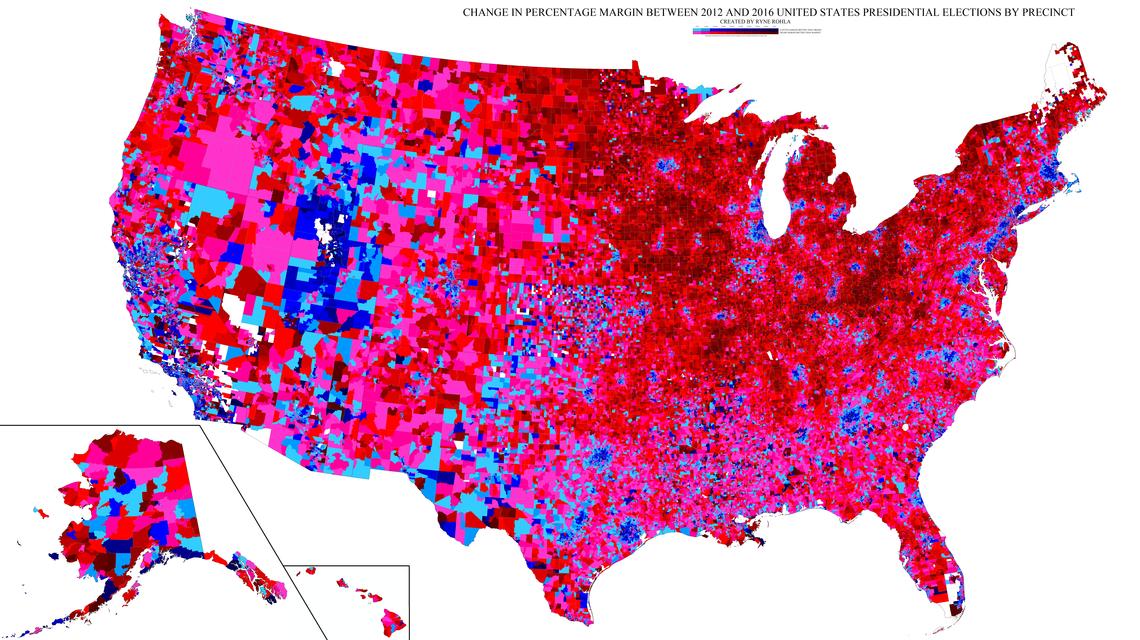
Now, the 21st century challenge of the Land-grant Institution has simply shifted from what Butterfield described. In many ways, the charge remains the same — Land-grant Institutions serve as the grand equalizers between urban and rural life, it’s just that the divide may no longer be socio-economic disparities. In a world increasingly strained by the same energy, water, and food crises of old, we’re faced with the challenge of increasing the empathy and understanding of an ideologically divided populace that questions the very relevance of an education.
This problem, the question of the continued relevance of Land-grant institutions, is of our own making. As Marcel LaFollete stated of research faculty in the book, “Stealing into Print: Fraud, Plagiarism, and Misconduct in Scientific Publishing“:
“To them, the word public is a dirty word. To them, their financial support just happens to come. Tax payers are never really seen as the source. If you look at the rhetoric, everyone talks about these issues as though funding just happened. It has been keeping them in a nice, middle-class life. The notion that the money came from people next door was a notion the community couldn’t grapple with. They were like politicians losing touch with their constituency. A sense of service just doesn’t fit into what they perceive is their reason for being.”
We’ve become obsessed with the metrics intended to describe our standing and placement among our peers. Not just as individuals, but as entire institutions. With this national and global focus and pursuit of the grand national funding whales, we’ve forgotten our identity in the roots of our rural and urban constituents. As evidence, when we as an institution looked inward to develop our Grand Challenges initiative in 2015, the first draft, as developed by WSU faculty, did not mention “Land-Grant” or refer to our charter mission once. After a steaming review from myself and others, the words were added into the final documents wherever possible. This shows that on many levels we, as an institution, have lost sight of our primary brand charter and mission. And as a result, we’re becoming a stepping stone for people seeking career advancement on the way to somewhere else. These traveling administrators hardly have the time to understand our own charter mission and brand promise, let alone the values of the people in our constituency.
Let me be clear, the problem is not the metrics. Metrics are important. The problem is focusing on the metrics, instead of the broader goals that implicitly drive the metrics. This metrics game focus, and competing to win, when our goal and mission is to bridge divides and connect, which everyone can win at, is a race to the bottom that won’t end well.
Re-discovering our Land and Mission
In 2019, WSU President Kirk Schulz, almost on a whim, decided to offer free copies to faculty of the new book “Land-Grant University For the Future: High Education for the Public Good” by Stephen M. Gavazzi and E. Gordon Gee (current president of West Virginia University and multiple other universities). Everyone of my colleagues I’ve asked are either reading it or have plans to read it. President Schulz has now scheduled a workshop to bring the authors to Pullman for community debate. The book offered a survey to all of the current presidents of Land-Grant institutions and tasked them with responding to the following positions:
- Concerns about funding declines versus the need to create efficiencies
- Research prowess versus teaching and service excellence
- Knowledge for knowledge’s sake versus a more applied focus
- The focus on rankings versus an emphasis on access and affordability
- Meeting the needs of rural communities versus the needs of a more urbanized America
- Global reach versus closer-to-home impact
- The benefits of higher education versus the devaluation of a college diploma
The authors frame this discussion within the goal of leadership via a service institution. Most will realize that these are forced dichotomies and that we really want all of the above. But the positions make you think strongly about what we are currently succeeding at, and how we could use our limited resources to position ourselves for sustaining success.
Now that I use this post to inform students of our Land-Grant mission, I hit the following point home: for WSU to remain relevant to our constituents takes engagement from the general public. We can’t help solve the problems of our region if our region doesn’t inform us of the problems they need solved. What will keep WSU relevant to you throughout your life? How will WSU remain a credible steward of our region’s future? How can WSU improve efficiency? Ultimately, how will WSU continue to fulfill what it means to be Land-Grant by bridging the urban-rural divide?