Background
Hydrogen has been the fuel of the universe since the Big Bang, accounting for approximately 75% of the universe’s baryonic mass formed in its earliest moments. Because of its abundance and fundamental role in cosmic evolution, hydrogen serves as a powerful diagnostic tool for understanding the universe around us. With a B.S. in Astrophysics from the University of Massachusetts Amherst, I was driven by a fascination with measuring hydrogen in the early universe. During this time, I worked on the commissioning of TolTEC, a 0.1 K cryogenic millimeter-wavelength camera now installed on the Large Millimeter Telescope (LMT) in Mexico. Coming from a primarily theoretical background, I was drawn towards this hands-on, multidisciplinary effort required to transform abstract physics into measurable quantities.
This experience with experimental instrumentation and cutting-edge research ultimately led me to HYPER, where I now measure hydrogen in a completely different way. At HYPER, my work focuses on the challenge of measuring liquid hydrogen for transportation applications—a difficult task due to hydrogen’s extremely low density and viscosity. Achieving reliable liquid-level measurements requires balancing accuracy, robustness, integration complexity, and operational constraints in a cryogenic environment.
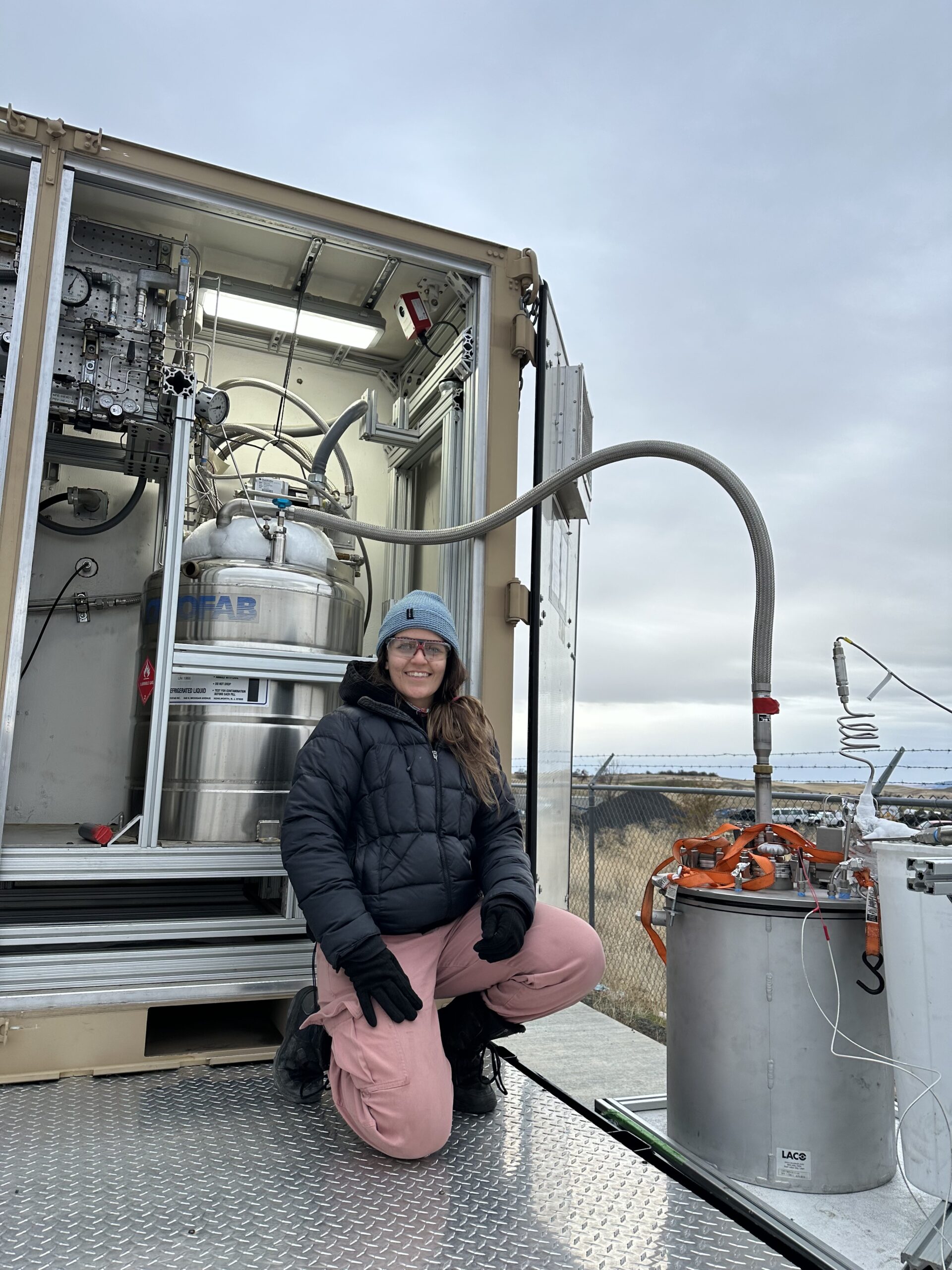
During my time at HYPER as a graduate student pursuing an M.S. in Mechanical Engineering, I have designed and built a liquid hydrogen test facility that enables direct, side-by-side comparison of level-sensing technologies under identical operating conditions. To meet the FAA requirement of 1% accuracy for liquid hydrogen level sensing, such controlled evaluation is essential. By creating the experimental foundation needed to rigorously validate these technologies, this work helps bridge the gap between laboratory innovation and certified, real-world systems—advancing the viability of hydrogen-powered flight for sustainable aviation.