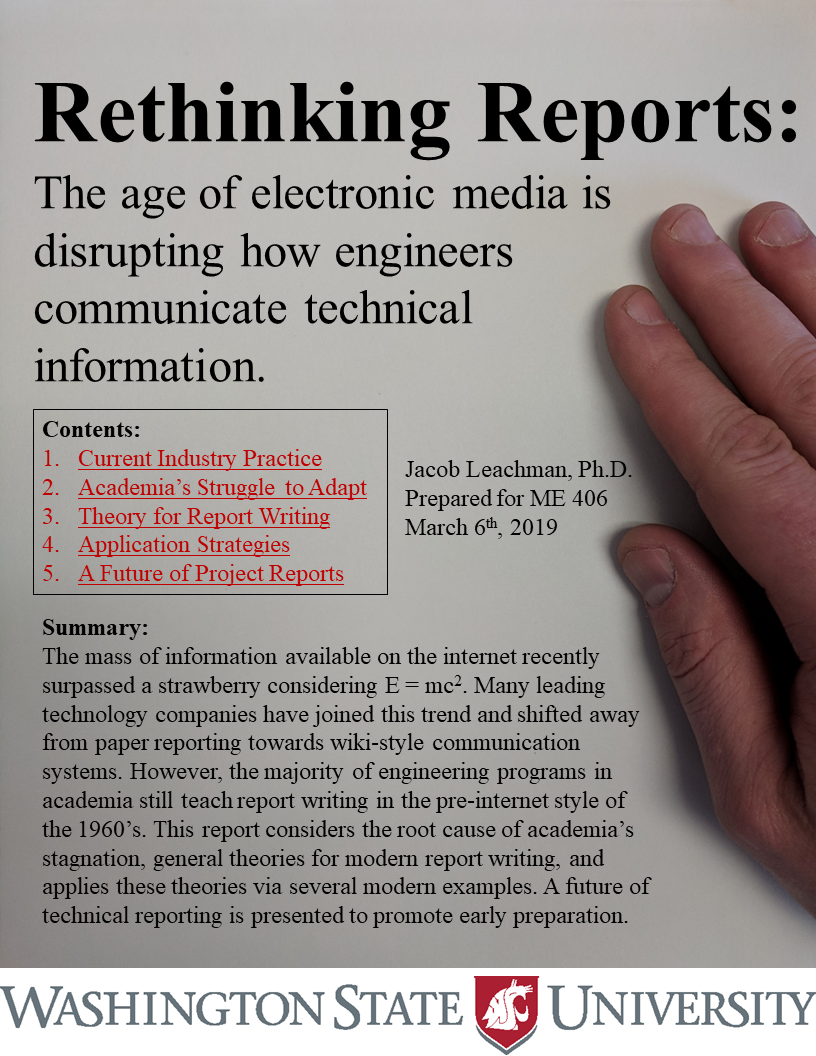
I created the image above back in 2019 to look like a cover page of a technical report students would typically submit in my ME 406: Experimental Design course. The hand is included to make a point — when is the last time you had to open a paper report by hand? Many of us in academia can quickly cite multiple examples. While many of us have remained reticent to digital trends enabled by the internet, times are quickly changing. The percentage of Americans using electronic-readers for pleasure reading is predicted to approach 30% by 2020. The question becomes when, not if, submitting a traditional paper report is considered as cumbersome and rude as bringing transparencies in for a lecture — the time won’t be long and, depending on your work community, may have already passed.
Current Industry Practice
When I was an undergraduate student we were required to maintain hand-written engineering logbooks of our work, as was common industry practice at the time. I was resistant and frustrated by this practice. The logbook stayed on my physical person, along with the information within, and was not useful to any of my teammates working on our projects — the very people needing to know what I was doing. So what was the point? Minimizing legal risk. I try to focus on quality engineering to minimize legal risk. It was 2005, and I looked for file-sharing systems that would enable this information-sharing future and help us to quickly adapt the information and file structure for others to use. But tools like Microsoft Teams or Slack had not yet emerged. Wikipedia was a fad trend.
Fast forward to today and things are very different. AI is completely disrupting and reshaping how we communicate and store information. Here are a few layers to consider:
- Large Language Models (LLM): Artificial Intelligence (AI) tools like ChatGPT or Claude allow a user to query an algorithm, which can return responses from a learning repository that are pretty good. Many of you could use these same tools to summarize this entire page. But user be warned, AI still makes drastic mistakes. I was in a meeting recently where AI described Wire Additive Arc Manufacturing (WAAM) as minimizing use of welds, when the entire part is inherently weld seams. So be cautious on controlling what you train your LLM with.
- Enterprise Management System: Companies will regularly have an internal database of standard knowledge, including how-to-guides, covering all aspects of company operations. These are often constructed in wiki- universes, wordpress, or the like and have search bars to query information. It is possible to have native LLMs that only reference information within the specific company data management system.
- Peer-to-peer communication systems: Many startup companies use tools like MS Teams and Slack to start communicating and aggregating data on specific topics or themes. While these help individuals communicate with eachother, they are just starting to use enterprise and LLM systems to be more useful. Typically though, a new company hasn’t generated sufficient information to warrant AI assists.
This is a far cry removed from the personal log-books I started my career with 20 years ago. In those days, the log books were primarily for legal documentation of engineering decisions that could be used in a court of law. I still use a logbook today, but for very different reasons. It’s more for helping my thought process and jotting down personal notes that I don’t need shared with others.
Academia’s Struggle to Adapt
There is an old adage — “Those who were abused tend to continue the cycle of abuse.” The very first post of this website describes a potential future for academia free of journal publications. But I’m still required to submit reports to journals for publication as the higher-ups in academia haven’t figured out better metrics to determine promotion and retention decisions. And the reviews I get back are getting worse and worse.
Why is academia, and specifically engineering, slow to adapt to new forms of reporting? In my opinion it’s laziness. The single fastest trend I’ve watched emerge in academia is the use of AI to reduce workload. But this is yet to disrupt publication practices.
Theory for Report Writing
The same rules for engineering communication still apply:
- Relevance (to your audience)
- Credibility (to your audience)
- Efficiency (to your audience)
Did you really expect anything else?
Application Strategies
The most common mistake young engineers make when writing technical reports is waiting until you’ve done all of the work to write the report. Write the report as the story is happening, when it is fresh in your mind. It’s this story of the struggle that is most relevant and empathetic for your audience who are experiencing your story for the first time.
The second reason I tell my students: “Report writing is a lot of work; anagous to running a marathon. But nobody else cares if you run the marathon in little bits over the course of an extended period of time or all in one shot — you are the only one that will end up caring.” Imagine if I waited until the end of the semester to write all of these communication posts for my class? Think I would have the time, patience, or memory to get it right? By drafting the post shortly before the lecture I’m able to go in to class with it fresh in my mind and I’m able to monologue or improvise off of my earlier thoughts with a straighter story.
What you’ll also notice is that this very document demonstrates the techniques I’m advocating students to apply for their report writing. One of the classic sayings for teaching by Lao Tze — “Tell me and I’ll forget. Show me and I may remember. Involve me and I’ll understand.” We jump right into showing and involving.
Given the amount of information we are expected to use, making your information skimmable is key. Here are a couple of tips:
- Use lists, tables, images, and headings to catch the eye.
- Your headings should do more than the minimum: Introduction. Try this instead: Introduction: How digital trends are disrupting report writing
- Subtle use of font changes to not overwhelm people.
- Focus on story telling. The words of your report simply connect the visuals you alread created for your presentations. Just write out the narrative as if you were presenting.
A Future of Project Reports
The need to tell the story of a project will never go away. However, how we deliver the story will change dramatically. As long is the relevance, credibility, and efficiency improves, you can imagine more dynamic interaction with reports. I fully anticipate a future where I will be able to use a report like this as a presentation because the media will be dynamic and embedded. A recording of me presenting the content will likely be posted to the end. People will be able to comment and add questions throughout, which I can quickly go back and adapt to resolve.
MME is already moving towards one such future with the Industry 4.0 manufacturing revolution. Industry 4.0 has four key principles:
- Interconnection: you already see how I’ve interconnected multiple media streams in this document.
- Information Transparency: you can imagine links to all of my report data and figures embed in this report for download.
- Technical Assistance: I’ve embedded links throughout to help you find more information if needed. You can also imagine an AI following along with your reading to assist you in more dynamic and powerful ways.
- Decentralized Decisions: Anybody within my lab system has access to this post and can change it if they spot a mistake. Anybody within the department can read this information and decide to make a change based on this content.
It’s tough to predict the future. It’s tough to think about what will come after Industry 4.0. It’s tough to think about what will supersede the internet. It’s tough to think about how fast information and technology is advancing. But what I do know is this — the future is happening, whether you’re participating in it’s realization or if it’s happening to you.
“Those who blaze the trail ultimately shape it’s outcome.” Ryan Holiday – Ego is the Enemy